


The previous piece, BookMyShow: The Case for Date-First Event Discovery, made the argument.
This one shows the product story - what got built, what works, what doesn’t.
Companion article deep-diving into the story of what building with Claude entails can be found here - BookMyShow: Building Date-First Discovery with Claude.
The argument was simple.
Most people don’t open BookMyShow knowing what category they want.
They know when they’re free.
They know where they want to be.
They want to see everything happening — and then decide.
But BookMyShow makes you pick a category first.
Movies. Events. Plays. Sports. Activities.
Only then do you get to filter.
That’s the wrong order.
The Show Board
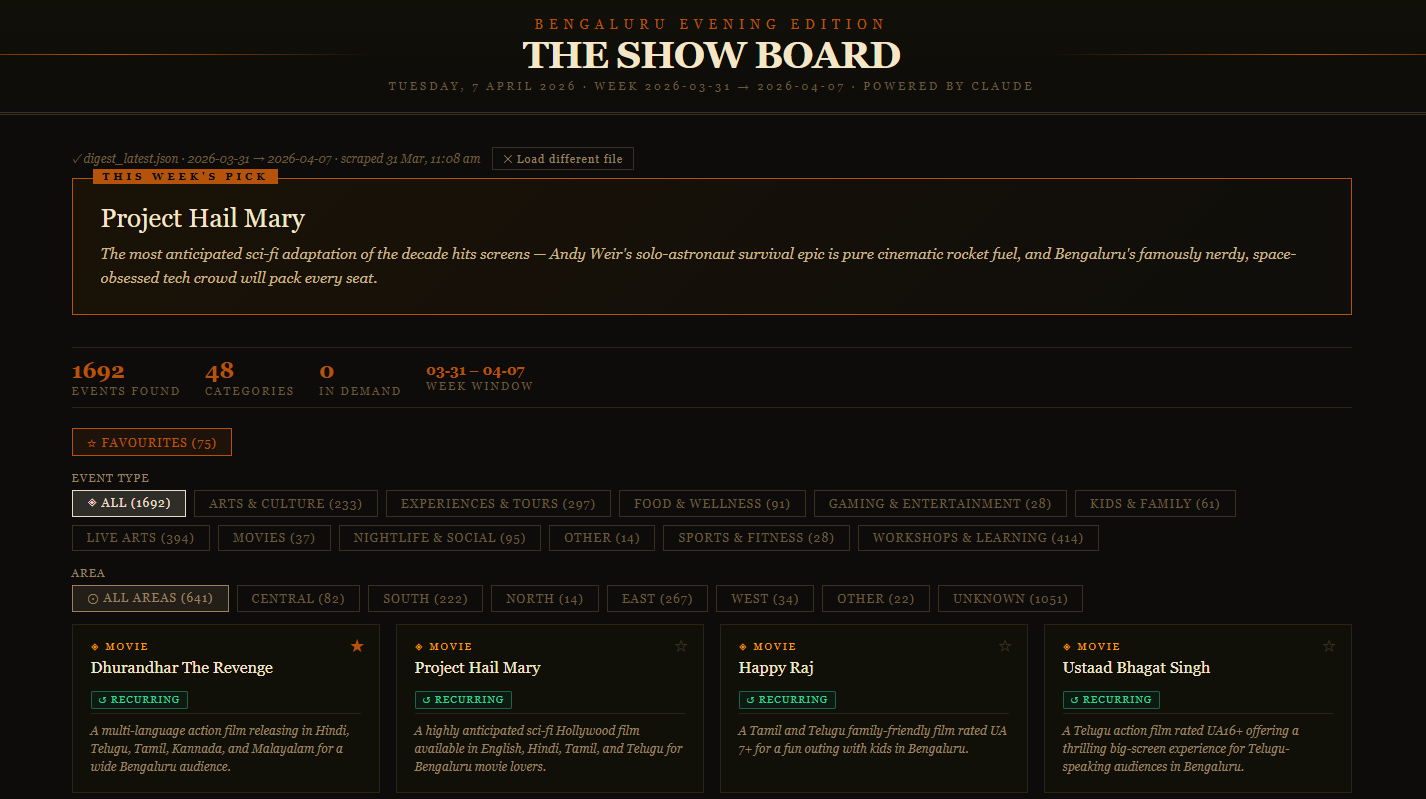
Currently live on buildthisnextonline.github.io/bms-showboard
The Bengaluru Show Board scrapes BookMyShow’s listings directly - movies, events, plays, sports, activities - curates them using Claude, and publishes a single browsable page every week.
1,700+ events. No login. No app. Just open the URL.
What good event discovery actually feels like
Finding something worth doing on a weekend is a three-stage process.
You start with a longlist.
You create a shortlist.
Then you finalize.
The existing BMS site makes this almost impossible. There’s no way to see everything at once. And there’s no way to bookmark anything for later - the “Interested” toggle is for notifications, not planning. So you either make a mental note, or you book right then and there. Neither is how people actually make decisions.
The Show Board changes that. It takes 15-20 minutes of toggling filters, starring events, and going through the Favourites list to get to a shortlist. That’s not fast. But it’s a fundamentally better process than going into Comedy, selecting a date, looking at listings, then going into Music, selecting a date, looking at listings, then going into Workshops - and having no way to hold anything across those searches.
The Show Board lets you see everything at once. And it lets you save what catches your eye.
That’s the starting point for how good event discovery should feel.
What got built - and what didn’t
The original proposal had four filters.
Event Type → ✅ Built
Two levels. Pick a broad group - Experiences & Tours, Live Arts, Sports & Fitness - then narrow to a specific type - Trekking, Concert, Comedy, Kayaking.
Filters work in both directions: selecting an area updates category counts, selecting a category updates area counts.
Location Areas → ✅ Built
Two levels. Pick a zone — South, North, East, Central, West — then narrow to a neighbourhood — HSR Layout, Indiranagar, Whitefield.
About 40% of events have no area data from BMS listing cards, so they appear under Unknown. Still discoverable. Just not geographically placed.
Shortlist → ✅ Built
A Favourites feature lets you save events across sessions. Saved events persist in your browser. If an event disappears from the next digest, it moves to a Past Favourites section — so nothing is lost between weeks.
The experience is exactly what the original proposal intended, just called Favourites instead of Shortlist.
Dates → ⚑ Partially built
This is the one that matters most, and it’s the piece that required a workaround.
BMS listing cards don’t always show specific dates. The scraper handles this by passing a 7-day window to Claude — today through today+7 — and asking it to only include events that fall within that window. Where dates are visible on the listing card, this works. Events outside the window get filtered out.
Where it breaks down: touring shows, multi-city events, comedy specials. These list the event name and venue but bury the actual dates inside a second-level page — one per city, one per date. The scraper doesn’t go that deep. So Claude sees no date, defaults to including the event, and it ends up in the digest regardless of whether it’s actually happening this week.
The result: date filtering works for events that surface their dates upfront. It doesn’t work for events that don’t. Which is a meaningful chunk of the listings.
Social visibility. ✗ Not attempted.
The opt-in social layer from the original proposal - seeing which friends are attending the same event - wasn’t attempted.
That requires user accounts, a social graph, and a backend.
None of which exist here.
What it costs to run
Building it →
$23.60/month (~₹2,360/month) for a Claude Pro subscription (including 18% GST).
Running it →
~$1.40 (~₹140) of API credits estimated per run - most recent run cost $3.42 (~₹342), reason unknown.
API credits are also subject to 18% GST, so $10 (~₹1,000) of credits costs $11.80 (~₹1,180).
Everything else →
Free — GitHub Pages, Python, Playwright, Chrome
At $3.42/run (~₹342/run) - plus GST on top - weekly automation would cost well over $200/year (~₹20,000/year) on top of the subscription. Not feasible. So it runs occasionally - when there’s a reason to.
An open offer to BookMyShow
This was built because what the original article argued for didn’t exist anywhere.
Not trying to compete with BookMyShow. Not trying to replace it.
Just trying to show what’s possible.
If someone at BookMyShow is reading this - the hypothesis has been tested, the prototype exists, and there’s a lot more to explore. Date-first discovery, shortlist-driven planning, the social layer - none of it is rocket science. It just needs someone willing to think it through properly.
That’s the kind of product building I love to do. If you’d like to talk, I’m available for Product Consulting.
The hypothesis that started this is BookMyShow: The Case for Date-First Event Discovery.
This is the product story behind this build.
The full technical build story is on Promptcraft: BookMyShow: Building Date-First Discovery with Claude.
Source code: github.com/BuildThisNextOnline/bms-showboard-code
I write about how products can be better — fixing what’s broken and imagining what’s missing.
If this made you notice something broken or missing, you can subscribe to Build This Next to receive future essays directly.
Every subscription is a vote for building better products.
And if this sparked an idea, take a few seconds to share it — it might help someone else build or see products differently.