


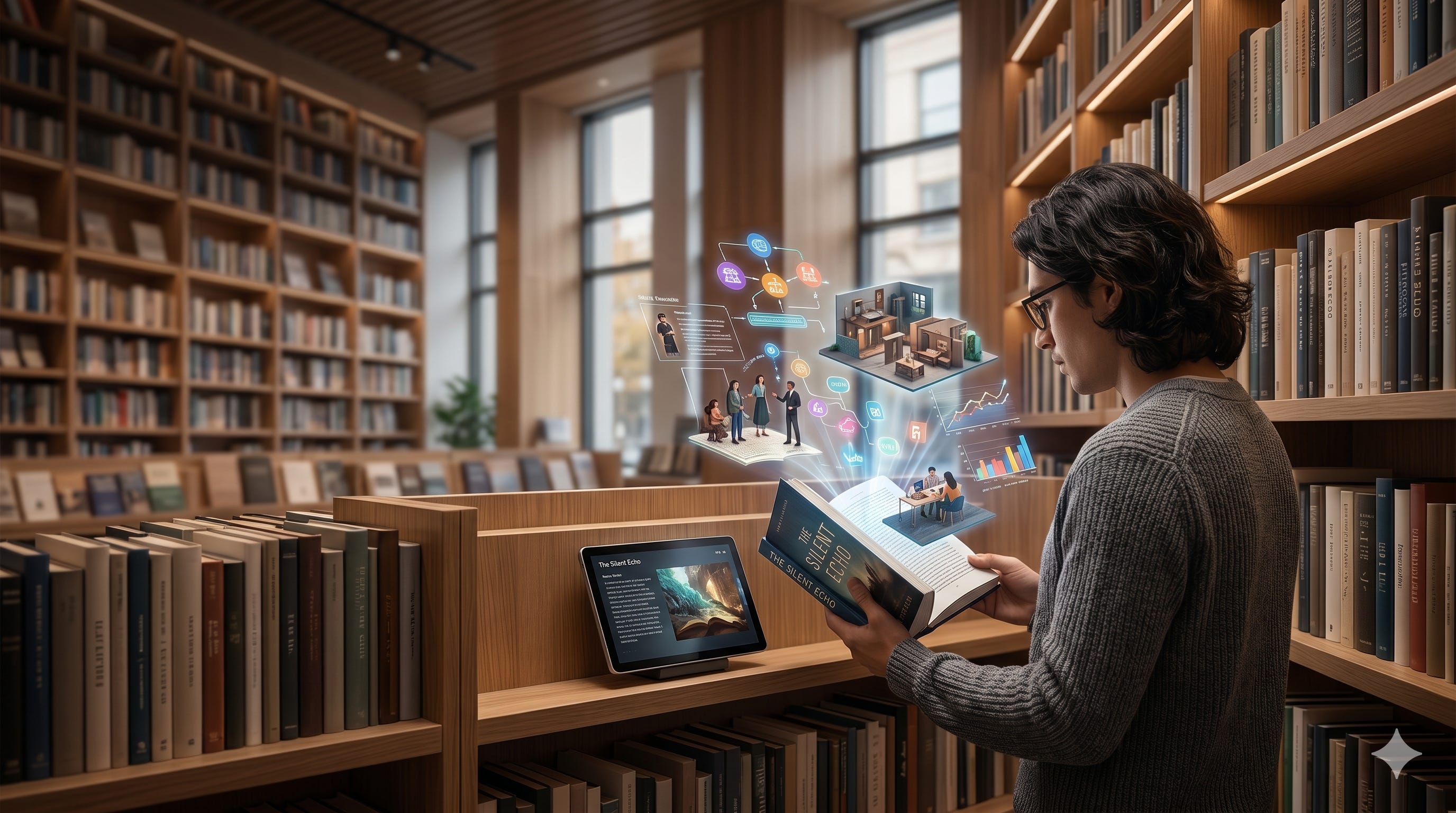
Walk into a bookstore and look around.
Thousands of books sit on shelves waiting to be discovered.
Most will never be picked up.
And most of the ones that are picked up will eventually be put back.
Not because they’re bad books.
Because they’re bad at introducing themselves.
Today, discovering a book is surprisingly primitive.
A potential reader typically has to:
Notice the book on a shelf
Like the cover
Read the title
Read the back-cover description
Guess whether it’s worth their time
Decide whether to buy it
For something that may require 10, 20, or even 50 hours of commitment, that’s remarkably little information.
Compare that to almost every other form of media.
Movies have trailers.
Podcasts have clips.
Courses have introductory videos.
Apps have demos.
Music has previews.
Books mostly have covers.
The Problem Isn’t Reading
The problem is discovery.
Most readers aren’t afraid of reading a good book.
They’re afraid of spending time on the wrong one.
A book may contain exactly the ideas someone is looking for.
But unless that person happens to find it, the book remains invisible.
In a world where attention is scarce, books are still relying on discovery mechanisms from decades ago.
Start With A Better Summary
Imagine every book had a concise, high-quality, AI-generated summary.
Not a plot spoiler.
Not marketing copy.
Not a generic description.
A genuine answer to the question:
“What will I learn, understand, feel, or see differently after reading this book?”
Perhaps 50 words.
Perhaps 100.
Just enough for someone to quickly understand whether the book is relevant to them.
That alone would dramatically improve discoverability.
Then Turn It Into A Trailer
Now take that summary and convert it into a 30-second video.
Not a cinematic trailer.
An idea trailer.
A short visual explanation of:
What the book is about
Who it is for
Why it matters
What makes it interesting
Imagine walking through a bookstore and being able to instantly watch a 30-second explanation of any book you’re holding.
The same way you might watch a movie trailer before deciding whether to spend two hours watching it.
The Bookstore Interface
Here’s where it gets interesting.
Instead of requiring QR codes, apps, or additional setup, every shelf could have a small screen, a camera, and a button.
You pick up a book.
You press the button.
You hold the book in front of the camera.
Within seconds:
The book is identified.
A concise summary appears.
A 30-second explainer video starts playing.
No app.
No account.
No search.
No friction.
Just curiosity answered instantly.
Libraries Could Benefit Even More
Libraries aren’t trying to maximize sales.
They’re trying to maximize discovery.
Which makes them an even better fit for this idea.
Imagine walking through a library and being able to explore dozens of books in minutes.
A student researching a topic could rapidly understand which books are relevant.
A casual reader could discover authors they would never have considered.
A visitor could leave with books they genuinely want to read rather than books they merely guessed might be useful.
A Channel Dedicated To Books
Take the idea one step further.
Imagine a platform dedicated entirely to book trailers.
Every book gets a standardized 30-second explanation.
Users can browse:
History
Economics
Psychology
Fiction
Philosophy
Science
Not by title.
Not by cover.
By ideas.
The result would be closer to discovering videos on YouTube than wandering through a bookstore hoping something catches your eye.
The Bigger Opportunity
The most interesting part of this idea isn’t the technology.
It’s the shift in perspective.
For centuries, books have been passive objects.
They sit on shelves waiting for someone to find them.
But books are really containers of ideas.
And ideas shouldn’t have to sit quietly hoping to be discovered.
They should be able to introduce themselves.
The Real Opportunity
Books are not becoming less valuable.
They’re becoming harder to discover.
The next innovation in reading may not be a better book.
It may be a better interface between readers and the ideas those books contain.
The future bookstore might not just display books.
It might help every book explain why it deserves your attention.
Build This Next.
I write about how products can be better — fixing what’s broken and imagining what’s missing.
If this made you notice something broken or missing, you can subscribe to Build This Next to receive future essays directly.
Every subscription is a vote for building better products.
And if this sparked an idea, take a few seconds to share it — it might help someone else build or see products differently.
You are trying to solve “ don’t judge a book by its cover” and in some cases a brilliant PR team.
I like supersummary for finding out if i want to read the whole book