


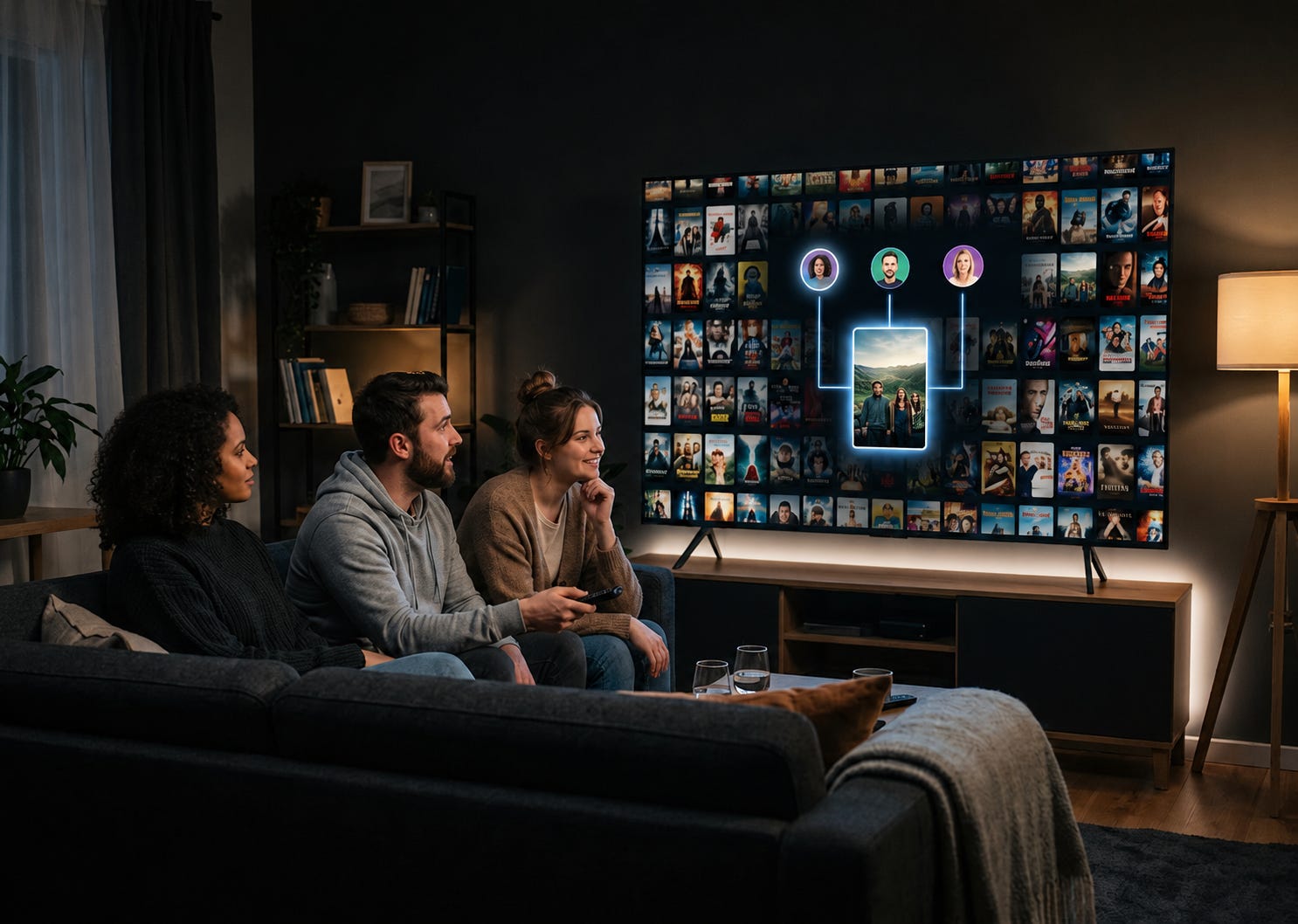
We don’t have a content problem.
We have a coordination problem.
Every group viewing session starts the same way:
“What do you want to watch?”
“Anything.”
“You pick.”
“Not that.”
“I’ve seen that.”
Fifteen minutes later, no one has pressed play.
Netflix has perfected personalization for individuals.
But most viewing doesn’t happen alone.
It happens with:
Partners
Roommates
Families
Friends
Watch parties
The product optimizes for me.
The real-world use case is often us.
That gap is worth building into.
The Feature: Group Match
Add one button:
Watching Together?
Tap it.
Select profiles (same household).
Or send an invite link for remote viewers.
Netflix returns:
Movies and series that none of you have watched — ranked by how much you’re likely to enjoy them together.
Not individually.
Together.
The Algorithm Isn’t About Excitement
If you average preferences, you get bad picks.
Group failure happens when:
One person loves it
One person hates it
The correct optimization isn’t maximum enthusiasm.
It’s minimum disappointment.
The best group choice is the one nobody regrets.
How It Works (Using Data Netflix Already Has)
Netflix already tracks:
Completion rates
Drop-offs
Rewatches
Genre affinity
Pacing tolerance
Maturity comfort
Time-of-day viewing
Step 1: Remove anything watched by anyone in the group.
Step 2: Build taste vectors for each user.
Step 3: Rank titles by lowest expected dissatisfaction.
Maximize shared satisfaction.
Minimize polarization.
Make It Transparent
Under each recommendation:
92% Group Match
Why?
All 3 of you finish slow-burn thrillers.
None of you completed this.
Similar groups finished it fully.
Trust increases when recommendations explain themselves.
Add Context Layers
Before generating results, ask:
What’s the vibe?
Light & Funny
Intense
Emotional
Comfort
Background-friendly
Add time filters:
Under 45 minutes
Under 2 hours
Pilot only
Binge-worthy
This turns the engine from reactive to intelligent.
Why This Is Strategically Important
This isn’t a UX tweak.
It shifts Netflix from:
Personal recommendation engine
to
Social coordination engine
The real friction isn’t discovering content.
It’s aligning humans.
If Netflix reduces time from app open → play, completion rates rise.
Completion drives retention.
Retention drives lifetime value.
The Second-Order Effects
Faster session starts
Higher group satisfaction
Lower churn in shared households
Stronger perception of intelligence
New data layer: how preferences interact socially
Netflix would no longer just understand what you like.
It would understand how your taste behaves in a group.
That’s a new dimension of personalization.
Why It Probably Doesn’t Exist Yet
Privacy sensitivities
Account sharing politics
Cross-region catalog complexity
Non-trivial optimization math
But technically? Very feasible.
Culturally? Inevitable.
Discovery is Hard. Agreement is Harder.
Finding something good to watch is hard.
Finding something good that everyone wants to watch is harder.
Netflix already knows what each of us likes.
The next opportunity is helping us discover what we like together.
Because the challenge isn’t just recommendation.
It’s coordination.
The future of streaming isn’t just answering: “What should I watch?”
It’s answering: “What should we watch?”
And the platform that solves that problem first won’t just have a better recommendation engine.
It will have a better understanding of how people make decisions together.
If someone at Netflix sees this:
Build This Next.
I write about how products can be better — fixing what’s broken and imagining what’s missing.
If this made you notice something broken or missing, you can subscribe to Build This Next to receive future essays directly.
Every subscription is a vote for building better products.
And if this sparked an idea, take a few seconds to share it — it might help someone else build or see products differently.