


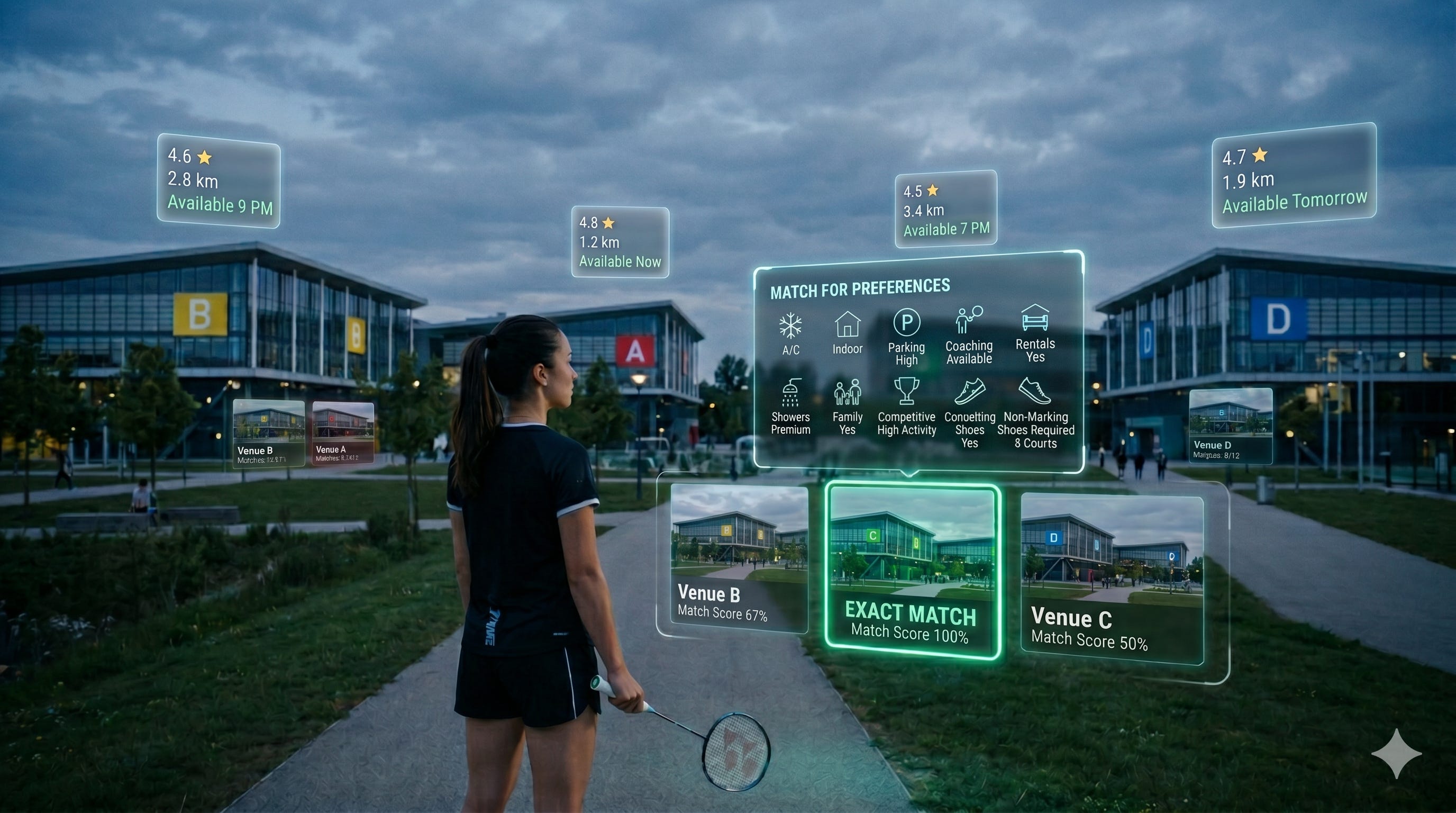
I was browsing Playo recently.
Like many sports apps, it does a good job helping you find venues, players, trainers, and games nearby.
You can filter by skill level.
You can sort by distance.
You can sort by ratings.
And that’s useful.
But after a point, those aren’t the questions most people are actually trying to answer.
The real question isn’t:
“Which badminton court is closest to me?”
The real question is:
“Which badminton court is right for me?”
And those are very different problems.
Imagine You’re Looking For A Badminton Court
You find three venues within 5 km.
All have good ratings.
All have available slots.
Which one do you choose?
You still don’t know:
Is it air-conditioned?
Is it indoor or outdoor?
Does it have 2 courts or 12?
Is parking available?
Can you buy water there?
Do they rent racquets?
Are non-marking shoes mandatory?
Do they have changing rooms?
Is coaching available?
Can you get there by metro?
Is the crowd casual or highly competitive?
The information that actually determines your decision is often missing.
Sports Venues Are Not Commodities
Two badminton courts are not the same.
Two football turfs are not the same.
Two gyms are not the same.
Yet many sports platforms treat venues as interchangeable inventory.
They optimize for:
Distance
Ratings
Availability
But players optimize for convenience.
And convenience is multidimensional.
Different Players Care About Different Things
A parent enrolling their child in coaching wants:
Qualified trainers
Safe facilities
Weekend batches
Parking
Waiting areas
A corporate employee playing after work wants:
Evening availability
Indoor courts
Showers
Easy parking
Nearby food options
A serious amateur player wants:
High-quality flooring
Competitive players
Coaching availability
Multiple courts
Tournament activity
A beginner might simply want:
Equipment rentals
Friendly crowd
No membership requirements
Flexible booking
The same venue can be perfect for one person and completely wrong for another.
The Missing Layer: Venue Intelligence
Imagine being able to filter venues based on the things that actually influence your decision.
Not just skill level, ratings, and distance.
But infrastructure, scheduling, equipment rentals, parking, amenities, coaching, community, accessibility, venue policies, and dozens of other practical considerations.
The exact interface might look something like this:
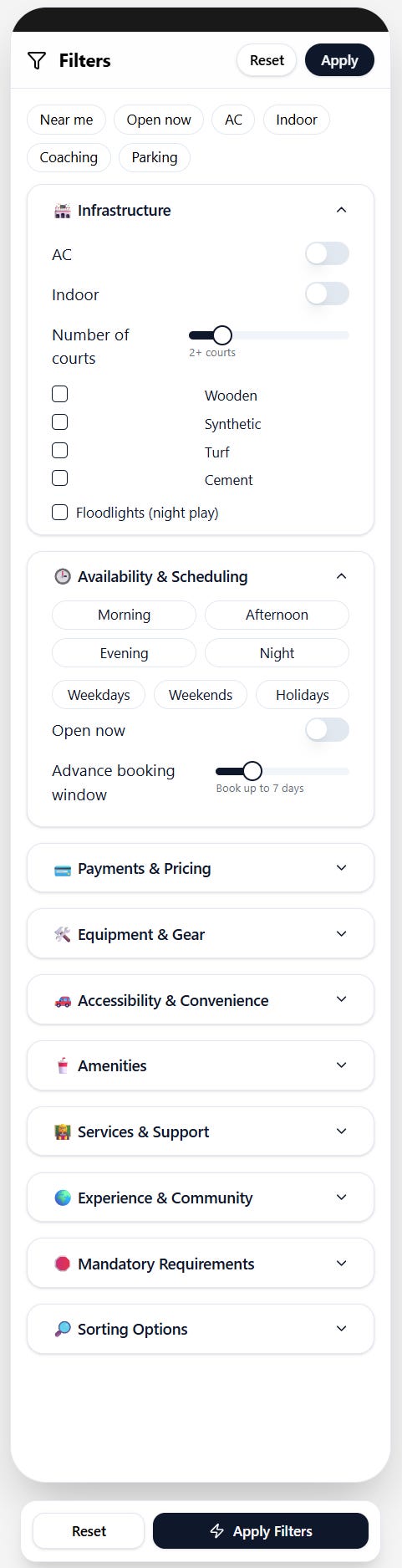
An example of what a richer sports venue discovery experience could look like.
The Filter Nobody Thinks About Until It’s Too Late
One surprisingly important category deserves its own section:
Mandatory Requirements
Because nobody wants to discover these at the venue entrance.
Imagine knowing beforehand:
Non-marking shoes required
Regular shoes allowed
Sports attire mandatory
Membership-only venue
ID required for entry
Minimum age restrictions
Walk-ins allowed or not
Every regular player has experienced this.
You arrive excited to play.
And then discover you can’t.
Not because the court is unavailable.
But because nobody told you the rules.
This Benefits Venues Too
Better filtering isn’t only useful for players.
It helps venues attract the right customers.
A premium indoor facility with AC, coaching, and showers shouldn’t compete solely on distance.
A community-focused beginner venue shouldn’t be judged by the same criteria as a tournament-focused academy.
Better filters allow venues to differentiate themselves on the dimensions they actually invest in.
Discovery Was The First Layer
Sports discovery platforms solved location.
The next challenge is context.
The future of sports marketplaces isn’t helping users answer:
“What venues exist near me?”
It’s helping them answer:
“Which one matches exactly what I’m looking for?”
Because finding a court isn’t the hard part.
Finding the right court is.
Build This Next.
I write about how products can be better — fixing what’s broken and imagining what’s missing.
If this made you notice something broken or missing, you can subscribe to Build This Next to receive future essays directly.
Every subscription is a vote for building better products.
And if this sparked an idea, take a few seconds to share it — it might help someone else build or see products differently.
More parameters for filtering the right venue would solve for this