


Substack is one of the best platforms I’ve used to publish long-form writing.
It’s clean.
It’s intuitive.
It removes noise.
And most importantly - it lets you focus on writing.
Over time, it has helped me build multiple newsletters across different themes, each with its own cadence, audience, and intent.
I like the control it gives me - over formatting, scheduling, and publishing.
But as I started taking publishing more seriously - not just writing occasionally, but building a pipeline of content - I started running into some very real limitations.
And the more I worked around them, the more one thing became clear:
Substack is designed for writers.
Not for publishers.
The shift most people don’t notice
If you write once in a while, Substack works perfectly.
You write → you publish → you move on.
But the moment you start thinking like this:
I want to publish every Monday at 11:30 AM
I have 20+ articles ready or in progress
I want to control sequencing and timing
I want to reorder based on what I write next
You’re no longer just writing.
You’re running a system.
And that’s where things start breaking.
Gap #1 - No tables = no structured thinking
This might sound like a small feature gap, but it’s not.
Substack has no native way to create even a basic table.
If you want to present structured information - comparisons, frameworks, breakdowns - you can’t.
The only workaround?
Build a table in Excel
Export or screenshot it
Paste it as an image
This is inefficient, inflexible, and breaks the reading experience.
But more importantly:
Tables are not formatting.
Tables are thinking tools.
They allow you to:
Compare ideas side-by-side
Build frameworks
Present layered concepts clearly
Scale complex ideas into simple grids
If you can’t structure information, you can’t scale ideas.
Gap #2 - Scheduling UX is fundamentally broken
This is where things go from inconvenient → painful.
Let me show you what it actually takes to change the schedule of a single post.
Phase 1 - Finding the edit option
You start on the Scheduled posts page.
You can see the date — but not the time.
There is no inline edit option.
So you click the three dots.

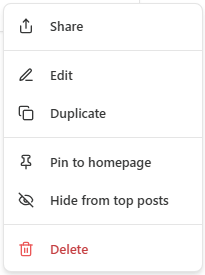
You click into Edit.
Phase 2 - Breaking the existing schedule
Then into another Edit.

Then into another modal.
And then you see this:

To change the schedule…
You first have to un-schedule the post.
This is like changing a meeting by cancelling it first — every single time.
Phase 3 - Rebuilding it from scratch
Now you start over.
Click on Continue

Re-enable scheduling

Open the calendar

Select the date
Scroll through hours
Scroll through minutes
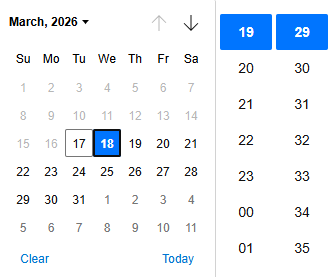
Confirm again

There is:
No quick edit
No inline change
No direct input
No keyboard entry
Just scrolling.
The math makes it worse
To reschedule a single post:
12–14 clicks
~20+ scroll interactions
Multiple context switches
Zero inline editing
Now multiply that by 13 posts in a pipeline.
That’s roughly 150–180 clicks and 250+ scroll interactions
just to insert a single post ahead of everything else.
You’re not managing a schedule anymore.
You’re doing manual labor.
The deeper problem (this is not just UX)
What makes this worse is that this isn’t just a UI issue.
It’s a system design issue.
Substack treats scheduling as a one-time action - not a persistent, editable state.
That’s why:
You can’t edit directly
You must “unschedule” first
You must rebuild every time
The system behaves as if scheduling is something you do once -
not something you manage continuously.
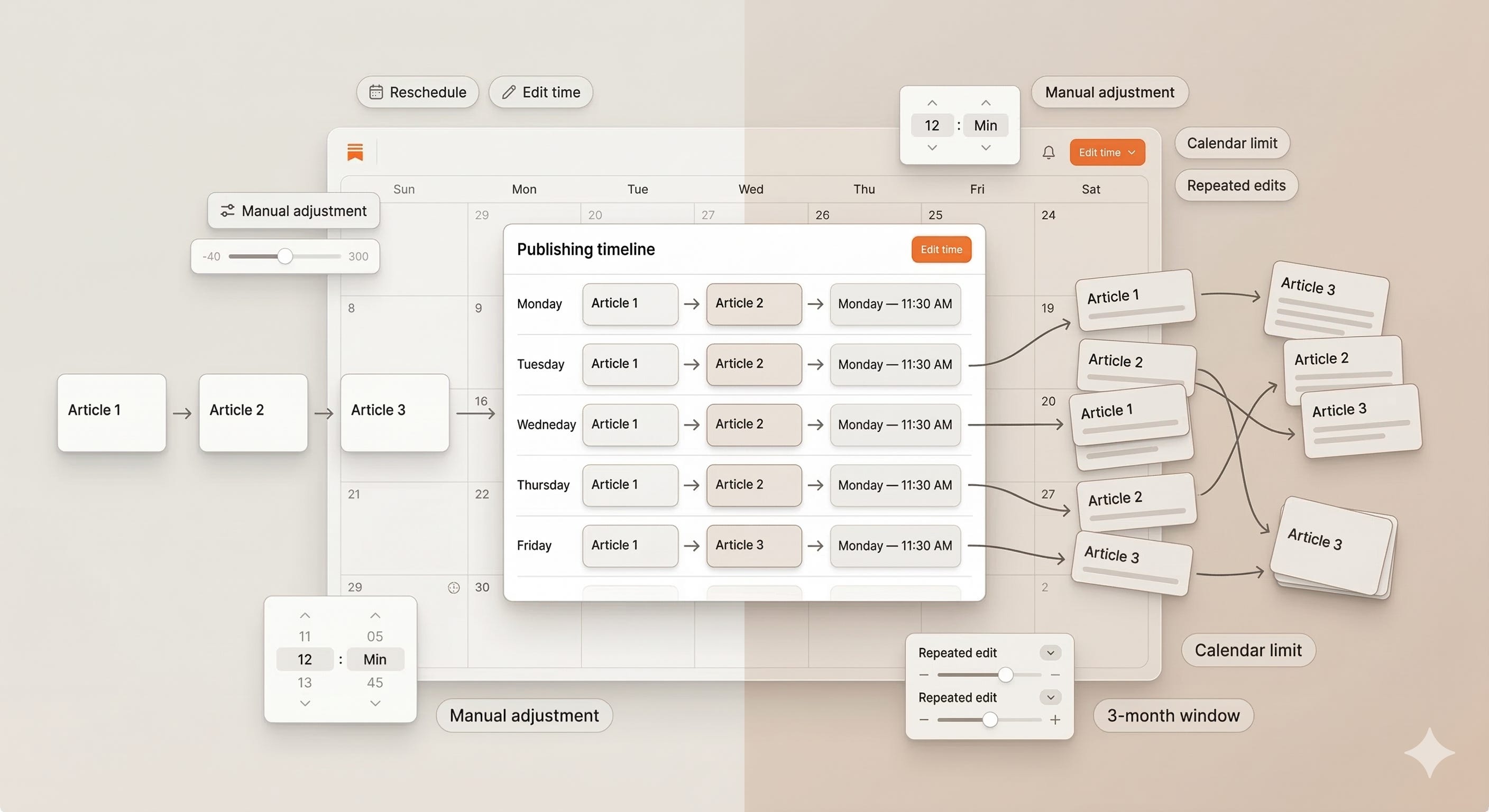
The missing piece: a content pipeline
Both of these problems - tables and scheduling - point to the same gap.
Substack treats posts as documents.
But serious users treat them as objects in a system.
What’s missing is a true publishing pipeline:
A calendar view of all posts
Visibility into both date and time
Drag-and-drop rescheduling
Bulk shifting (move all posts by +1 week)
Queue management (what goes out when)
Recurring slots (every Monday, 11:30 AM)
Right now, none of this exists.
So users build hacks.
The workaround is the signal
Here’s what I currently do:
Schedule posts at incorrect dates/times
Stack multiple posts on the same day
Use non-publishing days as placeholders
Gradually fix them as the 3-month window rolls forward
This is not a feature.
This is a workaround.
And it reveals something important:
The moment users start building systems outside your product,
they are telling you exactly what your product should become.
The 3-month window problem
There’s another constraint that quietly breaks serious usage.
Substack only allows scheduling up to 3 months in advance.
Which sounds reasonable — until you actually try to run a publishing pipeline.
If you publish once a week, that’s ~13 posts.
I already have more than that ready or in progress.
And if you’re serious about building a body of work, you will too.
The workaround?
You start gaming the system:
Scheduling posts on the wrong days
Stacking multiple posts on the same date
Using placeholder times
Constantly revisiting and fixing the schedule as the window rolls forward
In other words, you stop planning — and start maintaining.
But the deeper issue isn’t the workaround.
It’s what this constraint implies.
A 3-month rolling window assumes that publishing is short-term.
That creators think in weeks or months.
But serious publishing doesn’t work like that.
You’re building:
A backlog
A pipeline
A body of work
An audience over years - even decades
And my understanding is that Substack wants to be exactly that platform:
The place where long-term thinkers publish consistently and audiences build trust over time.
But a system that only lets you see 3 months ahead forces you to operate short-term.
Which creates a mismatch:
Long-term ambition
vs
Short-term tooling
You can’t build a long-term publishing system on top of a 3-month planning window.
This isn’t about adding features
Substack doesn’t need to become complicated.
But it does need to evolve.
Because publishing is no longer:
Write → Send
It’s now:
Plan → Sequence → Optimize → Publish
The bottom line
Substack is one of the best tools for writing on the internet.
But the moment you take publishing seriously -
when you move from writing occasionally to running a system -
you start working around the tool instead of with it.
And that’s the signal.
If someone at Substack sees this:
Build This Next.
I write about how products can be better — fixing what’s broken and imagining what’s missing.
If this made you notice something broken or missing, you can subscribe to Build This Next to receive future essays directly.
Every subscription is a vote for building better products.
And if this sparked an idea, take a few seconds to share it — it might help someone else build or see products differently.