


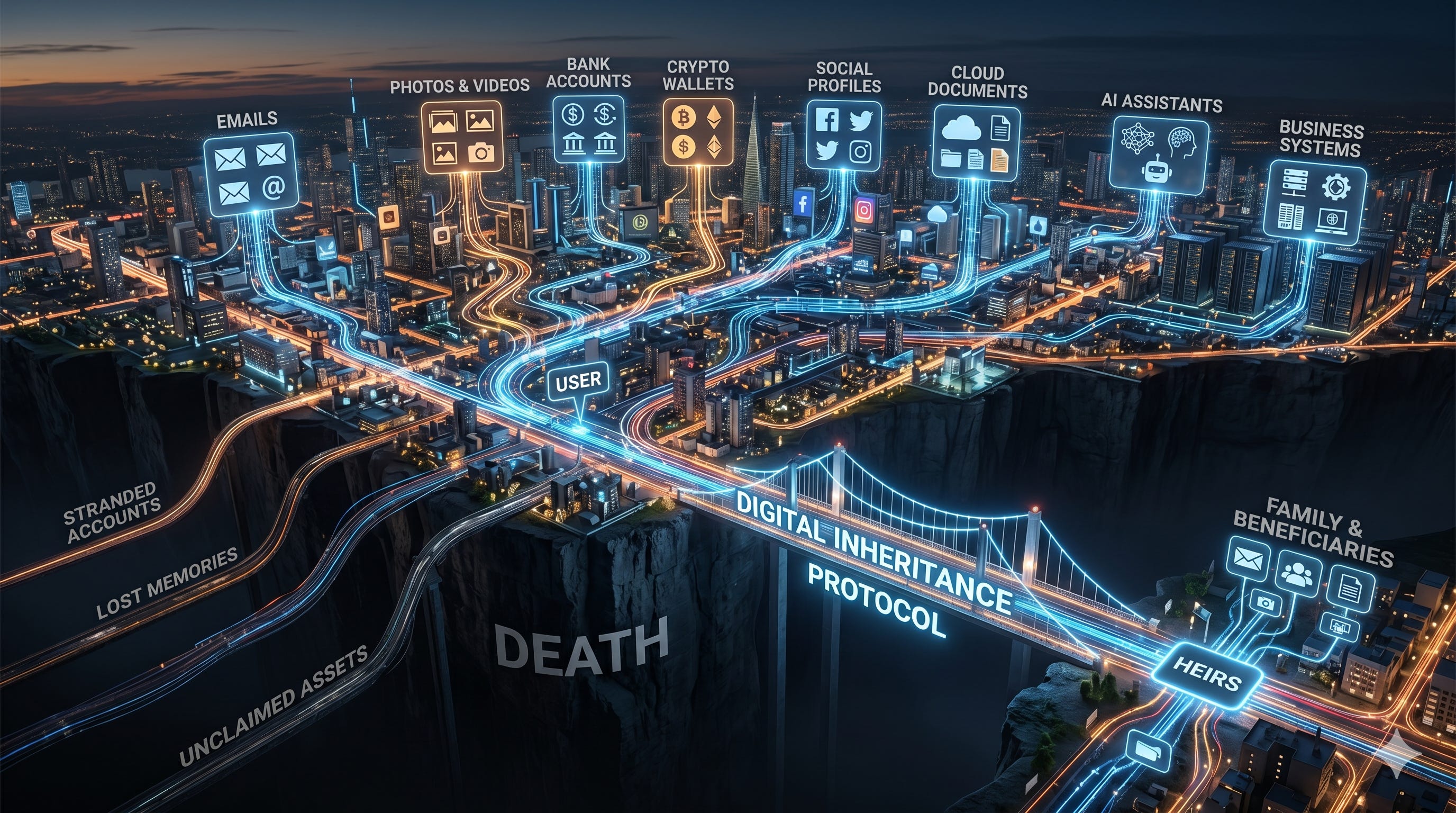
We are racing into a future no one is prepared for.
There are now more dead people on Facebook than living users. Millions of Gmail inboxes belong to people who will never log in again. Crypto assets worth billions are permanently lost every year because the person who held the keys is gone - and with them, access to everything they ever owned.
Family members are locked out of memories.
Children are locked out of assets.
Friends are locked out of last conversations.
And the internet keeps pretending death isn’t part of the user lifecycle.
We’ve solved onboarding.
We’ve optimized engagement.
We’ve automated customer retention.
But we’ve ignored a simple truth:
Every user journey ends in death. And there is no system for what happens after.
Digital Death Is the Next Big Failure in Product Design
Every major product company has been sleepwalking through this problem.
Apple has “Legacy Contact.”
Google has “Inactive Account Manager.”
Facebook has “Memorialization.”
Crypto wallets offer “seed phrases.”
Banks still insist on “contact the branch with a legal successor certificate.”
These are weak band-aids.
They assume:
The user will remember to hand over access details before they die.
They will have the time to do it.
They will trust someone with full access while still alive.
They will follow manual processes their families even know exist.
Their heirs will know passwords, find documents, understand probate, navigate bureaucracy, and guess which platforms the deceased even used.
Almost always, none of this happens.
And when it doesn’t, grief turns into chaos.
Bank accounts stay frozen.
Photos and messages disappear into corporate servers.
Investments are lost.
Crypto is unrecoverable.
Ongoing businesses tied to one person’s logins simply die.
Legal and financial abuse becomes easy.
We haven’t hit the peak of this crisis yet - but it’s coming. Fast.
The first true internet generation - millennials - will start dying in large numbers in the next few decades.
They are the first generation to live fully digital lives.
Social.
Financial.
Intellectual.
Creative.
Professional.
Emotional.
All online.
And unless we fix this now, we are walking into the largest silent digital collapse in history.
The Internet Needs an Inheritance Layer
The solution isn’t a “reset password when dead” button.
It can’t depend on customer support.
It can’t depend on government paperwork alone.
It can’t depend on a bank manager.
It can’t depend on your spouse knowing your passwords.
And it cannot depend on the account holder doing anything after they die - because by definition, they can’t.
Any solution worth building must be established while the user is alive, activate automatically after death, resist fraud, preserve privacy, work across platforms, comply with legal frameworks, and place as little burden as possible on grieving families.
Most importantly, it cannot depend on hope.
A Blueprint for Digital Inheritance
Here’s what a real solution looks like.
A user sets up a Digital Legacy Plan once in their life - a universal profile that securely defines who inherits access to their accounts.
Not passwords - access.
They choose what each person gets:
Financial accounts
Social accounts
Business tools
Notion, Drive, Dropbox
Crypto and digital property
Emails, messages, photos, notes, voice memories
AI agents and their personal instruction history (this becomes crucial soon)
Then they define a release policy:
Trigger: legal death record OR group attestation + inactivity
Delay period: 0–180 days
Scope: full access, partial, or archive export only
Privacy rules: what gets deleted before handover
When death is verified, the inheritance triggers automatically.
No begging Apple or Meta.
No browser hacking.
No detective work.
No lawsuits.
The heir is notified.
Access is transferred.
The human experience continues - with dignity.
No platform offers this today.
Not even close.
Why This Matters More Than People Realize
If we don’t solve this now, we’re heading into three disasters.
1. The Great Lockout
Trillions in value - financial, intellectual, and emotional - will be sealed away forever.
2. A Broken History
We are the first civilization to create permanent digital memories.
If we can’t preserve and pass them on, our era will become a fragmented historical black hole.
3. The AI Identity Crisis
Within five years, most people will have AI agents trained on their messages, writing style, voice, and decisions.
When a person dies, who owns that AI?
Who controls it?
That question alone will trigger lawsuits we aren’t ready for.
Death Is Not an Edge Case - It’s a Design Requirement
Every product team today thinks about onboarding flows, referral loops, churn curves, and LTV/CAC ratios.
How many think about account succession?
Estate transfers?
Data rights after death?
Almost none.
This isn’t a feature.
It’s a missing layer of digital civilization.
The internet has authentication, payment, identity, and messaging - but no protocol for mortality.
The company that solves this - cleanly, securely, globally - will define a new category.
It’s bigger than fintech.
Bigger than crypto custody.
Bigger than identity.
It’s bigger than social.
It’s the infrastructure of trust for a world where lives are digital.
This isn’t optional anymore.
Someone has to build it.
Build This Next.
I write about how products can be better — fixing what’s broken and imagining what’s missing.
If this made you notice something broken or missing, you can subscribe to Build This Next to receive future essays directly.
Every subscription is a vote for building better products.
And if this sparked an idea, take a few seconds to share it — it might help someone else build or see products differently.
Interesting and very important issue Kamal. like everyone else as highlighted in your article , I was in oblivion towards this issue.