


I was reading the plot summary of a movie on Wikipedia recently.
A few paragraphs in, I realized I was spending more effort remembering who everyone was than understanding what was happening.
“Michael betrays David, who had earlier warned Sarah about Alex, while Emma discovers...”
Wait.
Who is Michael again?
Was David the police officer?
Or the brother?
And who was Sarah?
At that point, I wasn’t reading a plot summary anymore.
I was solving a memory puzzle.
The problem is that Wikipedia assumes readers can keep a mental map of every character name while reading.
In reality, most of us don’t remember characters by name.
We remember faces.
We remember actors.
We remember visual cues.
We think:
“Oh, that’s the guy from the poster.”
“That’s the actress who played the sister.”
“That’s the villain.”
Not:
“Ah yes, that’s Inspector David Smith, son of Robert Smith and brother of Sarah Smith.”
Wikipedia already has all the information needed to solve this problem.
Every movie page contains the cast list.
Every actor already has a profile page.
Most actors already have photos.
Yet the plot section remains a wall of text.
The fix is surprisingly simple
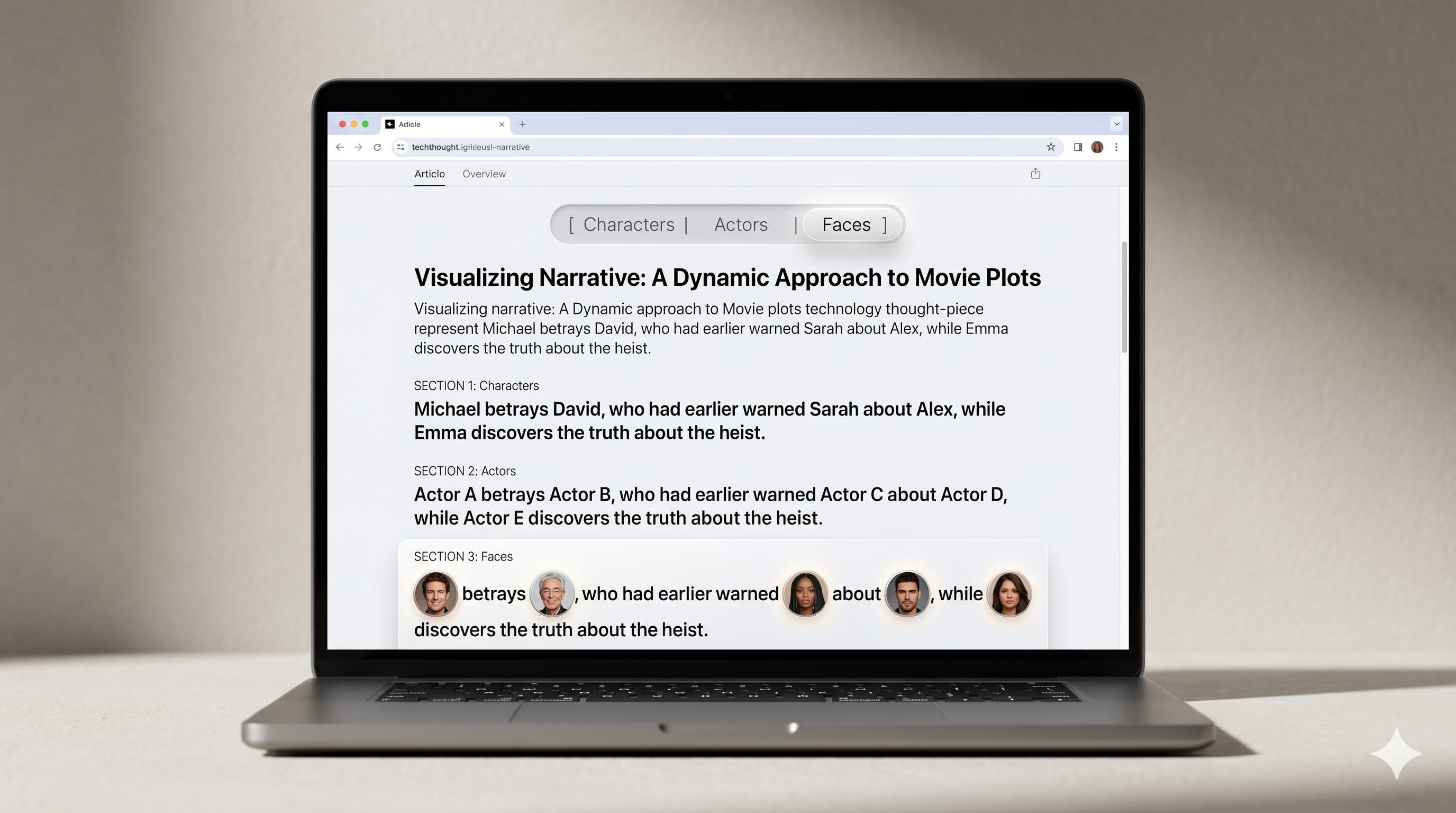
Instead of forcing readers to use character names, Wikipedia could let them choose how they want people to be represented.
Imagine a simple toggle at the top of every plot summary:
Characters | Actors | Faces
The plot itself never changes.
Only the representation does.
In Characters mode, you would see:
Michael betrays David, who had earlier warned Sarah about Alex, while Emma discovers...
In Actors mode, you would see:
Harrison Ford betrays Tom Hanks, who had earlier warned Emma Stone about Matt Damon, while Anne Hathaway discovers...
And in Faces mode, the names would simply be replaced by small headshots embedded directly within the sentence.
The story remains identical.
The cognitive load changes dramatically.
You no longer need to keep scrolling back to the cast section.
You no longer need to open multiple tabs.
You no longer need to remember six names introduced ten paragraphs earlier.
The plot becomes easier to follow because humans are fundamentally visual creatures.
The goal isn’t to add information. It’s to reduce the effort required to process information.
Even better: use actor photos instead of character names
Here’s the counterintuitive part.
In many movies, I know the actor far better than the character.
I may not remember Dr. Richard Kimble.
But I definitely remember Harrison Ford.
I may not remember Captain Miller.
But I definitely remember Tom Hanks.
For many readers, the actor’s face is actually a stronger memory anchor than the character’s name.
That’s why the toggle matters.
Different people remember different things.
Some remember characters.
Some remember actors.
Some remember faces.
A good interface should accommodate all three.
A small headshot often communicates more information than the text beside it.
This doesn’t stop with movies
The same problem exists everywhere.
TV series.
Anime.
Books.
Historical events.
Political timelines.
Corporate histories.
Whenever an article contains multiple people, readers are forced to build a mental lookup table of names.
Visual references dramatically reduce that cognitive load.
Imagine reading the history of a company acquisition and switching between:
Names | Job Titles | Photos
Or reading a political scandal and switching between:
Politicians | Parties | Faces
The article becomes easier to understand without becoming longer.
Why this matters
Most product improvements don’t come from adding information.
They come from reducing friction.
Wikipedia has spent decades solving the problem of information availability.
But there’s still a huge opportunity to improve information usability.
Because sometimes the difference between understanding a story and abandoning it halfway isn’t the quality of the writing.
It’s simply being able to remember who’s who.
And for humans, faces are often a far better index than names.
Maybe the future version of Wikipedia won’t just tell us what happened.
It will help us keep track of the people it happened to.
The Opportunity
Wikipedia already knows who every character is.
It already knows which actor played them.
It often already has a photo.
The missing piece isn’t information.
It’s presentation.
A simple toggle between Characters, Actors, and Faces could save millions of readers from repeatedly jumping between the plot section and the cast list.
And sometimes, that’s all great product design is:
Making information easier for humans to understand.
If someone at Wikipedia sees this:
Build This Next.
I write about how products can be better — fixing what’s broken and imagining what’s missing.
If this made you notice something broken or missing, you can subscribe to Build This Next to receive future essays directly.
Every subscription is a vote for building better products.
And if this sparked an idea, take a few seconds to share it — it might help someone else build or see products differently.