


Zerodha’s SIP system inside Kite for stocks and ETFs forces you into a date-based, monthly-only structure.
You pick:
1st
2nd
3rd
…
Up to 5 such dates
And that’s how your SIP runs.
If the market is closed, it runs the next day.
This works — but only in the most primitive sense.
It completely ignores how people actually think about recurring actions.
And it is the only part of an otherwise beautifully designed platform that hasn’t evolved in years.
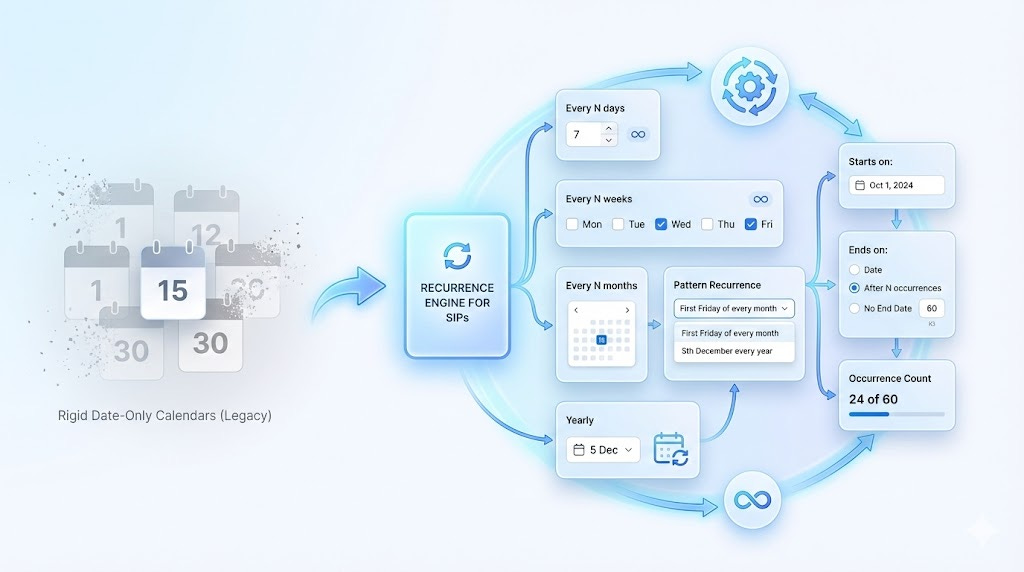
What Zerodha SIPs Look Like Today


Everything is based on:
A fixed date
Repeated monthly
With no understanding of patterns, weeks, or behaviour cycles
Weekly SIPs require hacks like:
Picking 1st, 8th, 15th, 22nd, 29th
Or picking 1st, 2nd, 3rd, 4th, 5th to simulate “every weekday”
This isn’t intuitive.
This isn’t elegant.
And it isn’t how modern software thinks about recurrence
What Outlook (and Google Calendar) Already Solved Years Ago
Look at how recurrence works in Outlook — arguably the best designed recurrence engine ever created.


You can choose:
✔ Daily
Every day, or every X days.
✔ Weekly
Every week, or every X weeks.
And you can choose specific days:
Every Friday
Every Tuesday & Thursday
✔ Monthly
Two modes:
Date-based:
5th of every month
Weekday-pattern-based:
First Friday of every month
✔ Yearly
Specific date (5 Dec)
Specific weekday pattern (first Friday of Dec)
✔ End Conditions
End after X occurrences
End on a specific date
Or never end
This is what users already understand.
This is what feels natural.
This is what makes recurrence comprehensible.
Kite SIPs Should Work Like This
Here is a crisp, minimal feature spec Zerodha could implement.
1. Choose Frequency
Daily
Weekly
Monthly
Yearly
2. Configure Based on Frequency
A. If Daily
Every day
Every X days
Great for systematic accumulation strategies.
B. If Weekly
Show weekday checkboxes:
☑ Mon
☑ Tue
☑ Wed
☑ Thu
☑ Fri
This instantly creates:
“Every Friday SIP”
“Every Tue & Thu SIP”
No hacks needed.
C. If Monthly
Two modes:
1. Date-based
1st, 2nd, 3rd, etc.
2. Pattern-based
First Friday
Second Monday
Last Wednesday
Much closer to how real-world patterns work.
D. If Yearly
Two options:
On date (e.g., 5 Dec)
On pattern (e.g., first Friday of December)
3. End Conditions
Just like Outlook:
Ends on a date
Ends after X cycles
Or never ends
A missing piece in Kite today.
4. Summary Preview
Outlook-style:
“Occurs every Tuesday and Friday at 09:30 until May 2026.
If the market is closed, it will trigger on the next trading day.”
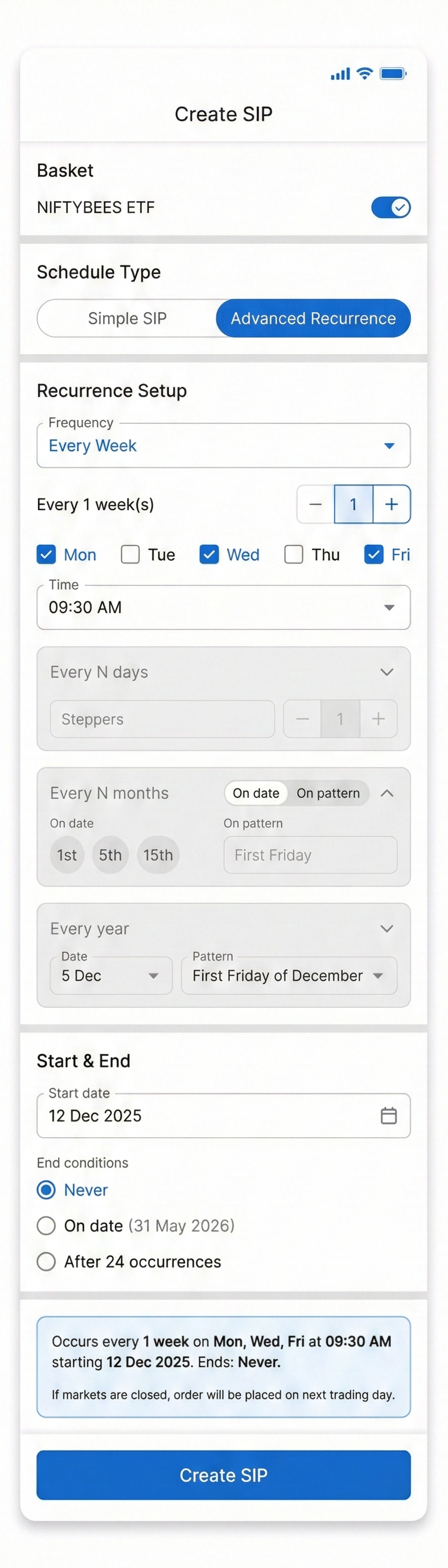
This reduces cognitive load and removes ambiguity.
Why This Matters
For Users
Real weekly SIPs become effortless
No need for manual hacks
Investing behaviour matches mental models
Adds flexibility without complexity
For Zerodha
Higher ETF SIP activation
Stronger user stickiness
Clear differentiation from other brokers
Very small engineering lift for very large UX gain
This is a classic high-impact, low-effort product win.
A Simple Upgrade With Outsized Impact
Kite is one of the best investing UIs in the world.
But this is one place where the recurrence model feels frozen in time.
People don’t think in dates.
People think in patterns.
Calendar apps already solved this.
Investing platforms simply haven’t adopted it yet.
This is an opportunity hiding in plain sight.
If someone at Zerodha sees this:
Build This Next.
I write about how products can be better — fixing what’s broken and imagining what’s missing.
If this made you notice something broken or missing, you can subscribe to Build This Next to receive future essays directly.
Every subscription is a vote for building better products.
And if this sparked an idea, take a few seconds to share it — it might help someone else build or see products differently.
For Zerodha, I assume most of their customers are on a monthly salary. So having fortnightly, weekly, daily is an option which will be hardly used.