


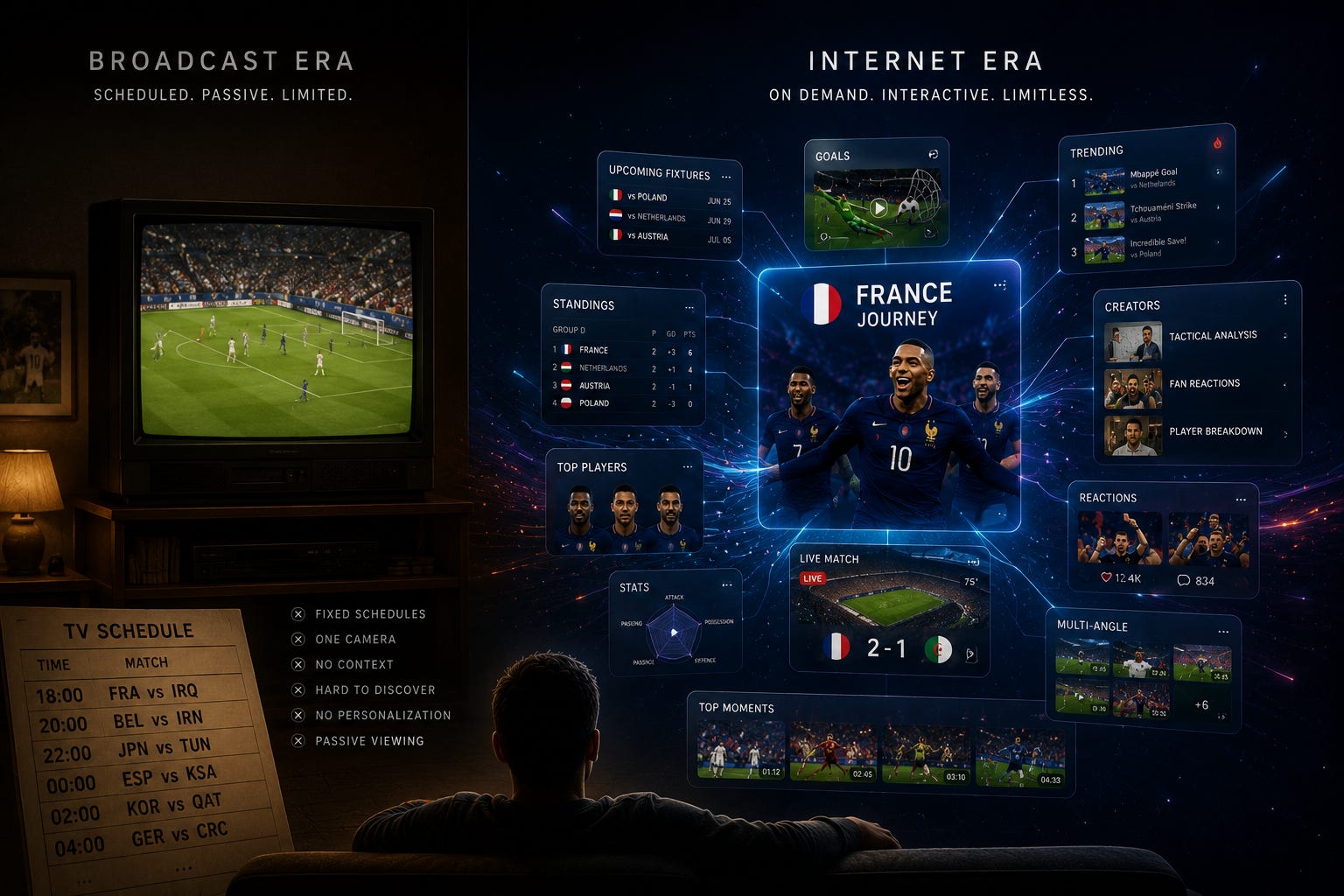
I was recently browsing FIFA+ on Zee5 during the 2026 World Cup and was struck by how familiar the experience felt.
A grid of videos.
A collection of highlights.
A digital version of a television archive.
Nothing was broken.
But nothing felt native to the internet either.
Sports streaming has come a long way from simply putting live television online.
Platforms like Zee5 now offer highlights, themed collections, historical matches, player features and editorial programming that go well beyond a simple list of live broadcasts.
That’s real progress.
But the underlying product philosophy still feels rooted in television.
Most experiences are still organized around content that publishers want to surface, rather than around the interests, journeys and curiosity of individual fans.
Matches
Broadcast schedules
Single camera feeds
Passive viewers
The technology has evolved.
The product hasn’t.
Sports streaming learned how to display videos.
It never learned how to help people discover them.
Television organized sports around broadcasts.
The internet should organize sports around curiosity.
The future of sports streaming isn’t better video quality.
It’s better information architecture.
Fans Don’t Follow Matches. They Follow Stories.
Most sports platforms organize content around individual matches.
France vs Iraq.
Belgium vs Iran.
Japan vs Tunisia.
That made sense when matches were the primary unit of distribution.
But fans don’t think in matches.
They think in stories.
A French supporter isn’t following France vs Iraq.
They’re following France.
They’re following a journey.
The platform should reflect that.
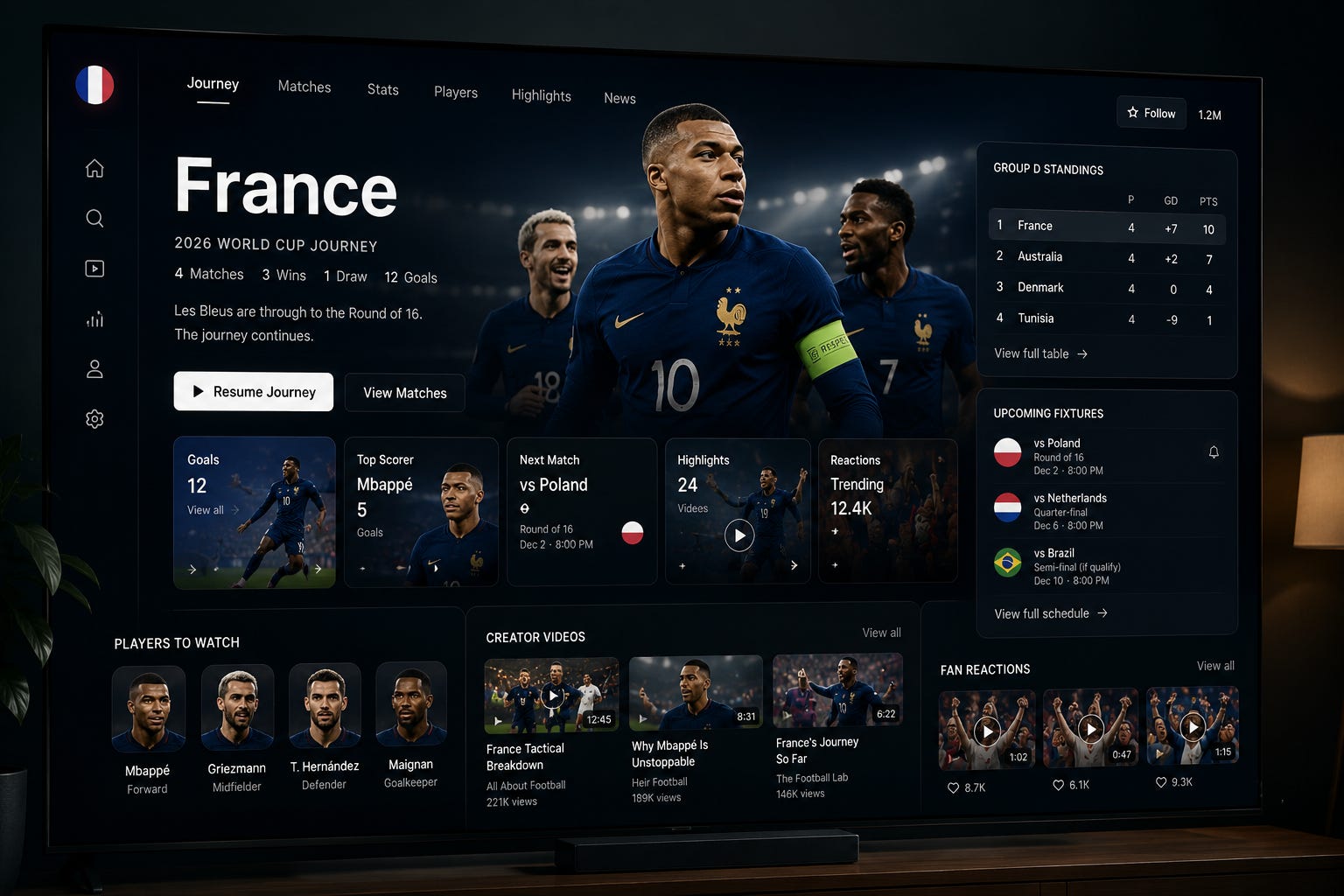
Imagine selecting France and instantly seeing:
Every match
Every result
Every goal
Every save
Every highlight
Group standings
Upcoming fixtures
Key players
Tournament progress
Some platforms have already started moving in this direction by creating team hubs and curated collections.
But they’re still largely collections of videos.
What I’m describing is something different.
A country shouldn’t be another playlist.
It should be a living object inside the product.
The World Cup is fundamentally a narrative.
Most sports platforms still present it as a collection of disconnected broadcasts.
Stop Optimizing For Existing Fans
One thing building my World Cup prediction engine taught me is how many countries I didn’t know much about.
The tournament helped me learn.
The interface didn’t.
Sports products are often optimized for people who already know sports.
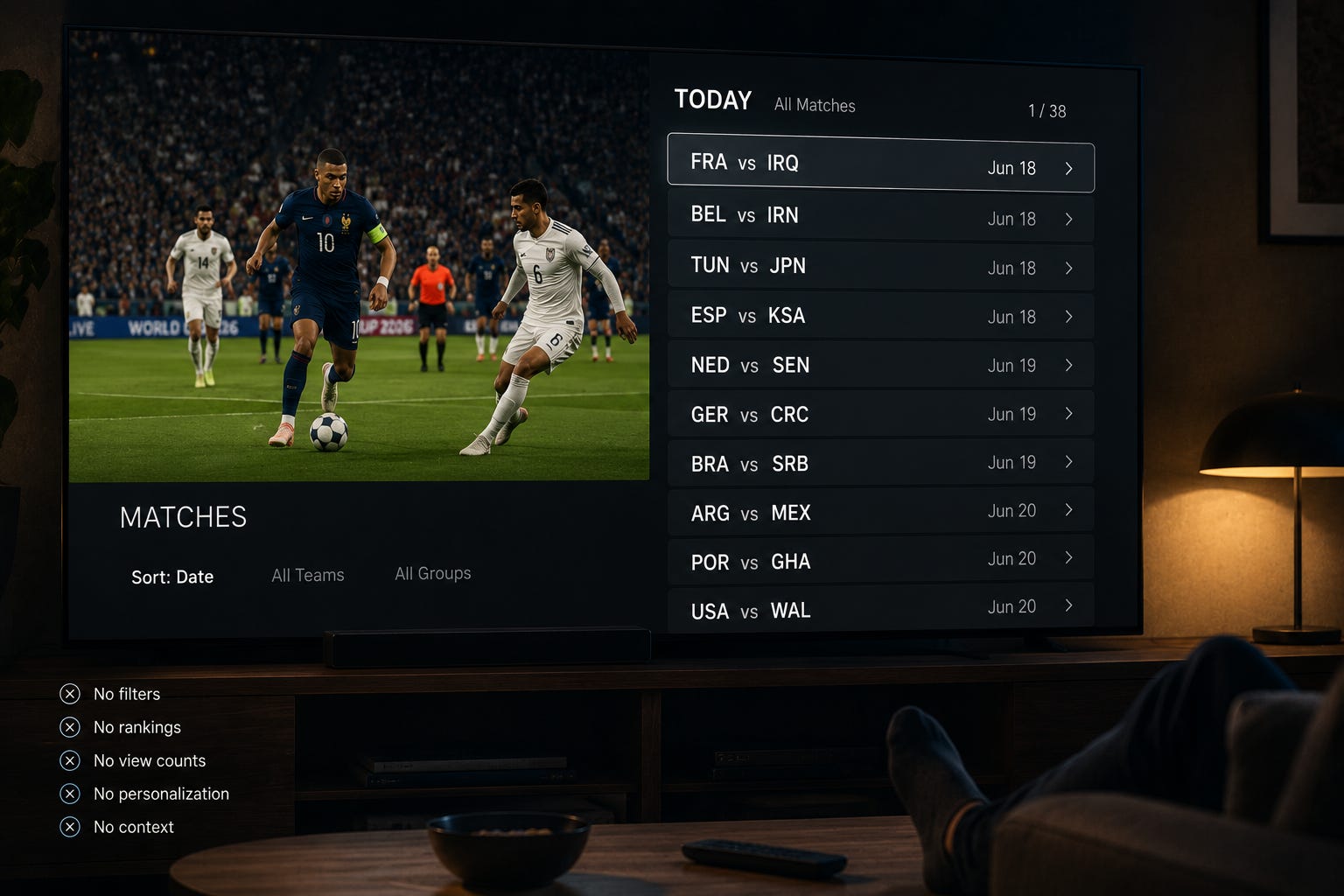
Take team abbreviations:
FRA vs IRQ
BEL vs IRN
TUN vs JPN
Sports fans instantly decode these.
Casual fans don’t.
New fans definitely don’t.
Why make people perform translation work before they can decide whether they’re interested?
Why not simply write:
France vs Iraq
Belgium vs Iran
Tunisia vs Japan
Instead of helping people discover stories, many sports interfaces quietly assume people already know them.
Good product design reduces friction.
It doesn’t test for prior knowledge.
The same philosophy applies throughout the experience.
Don’t make me remember which match contained the goal.
Let me start with the player.
Or the country.
Or the tournament.
Or even the moment.
The interface should adapt to how people think — not ask people to adapt to how the database is organized.
Stop Making Sports Streaming Feel Like A File Browser
Sports streaming platforms still behave as though the main job is to show users a chronological archive.
Match by match.
Date by date.
Three-letter acronym by three-letter acronym.
The industry has already started moving beyond this.
Platforms like Zee5 now surface highlights, themed collections, player features and editorial categories that make discovery significantly better than it was just a few years ago.
But those improvements still largely organize videos.
They don’t organize interests.
There’s still no meaningful filtering around what I actually care about.
No public ranking.
No view counts.
No clue what has already been watched.
No way to browse the tournament the way I browse the rest of the internet.
This is not how people discover content anymore.
Give us menus.
Give us sub-menus.
Give us filters.
Give us sorting.
Give us view counts.
Give us trending clips.
Give us country journeys.
Give us player feeds.
Give us top goals.
Top saves.
Top assists.
Top controversies.
Top reactions.
Let me follow penalty shootouts.
Or underdog stories.
Or bicycle kicks.
Or goalkeeping.
Or counterattacks.
Or just everything related to Argentina.
Curiosity is personal.
The interface should be too.
Make the TV experience feel closer to an app or a video game.
Let me use my remote.
Let me use my phone as the controller.
Let me open a companion app if that is easier.
Millions of people already navigate sophisticated interfaces on their TVs every day.
YouTube has already trained people to browse, sort, search and discover.
Video games have already trained people to use layered menus without panicking.
We got this.
Today’s sports platforms are still largely asking:
“Which video do you want to watch?”
They should be asking:
“What are you interested in today?”
What we don’t need is another page of match cards auto-sorted by date, forcing us to guess whether we’ve already seen a match between two teams represented by acronyms we may not even recognize.
The platform knows the content.
The platform knows the user.
The platform knows what is popular.
The platform knows what has been watched.
The interface should act like it knows.
Stop Hiding Information From People Who Already Know It
One of the strangest conventions in sports media is hiding scores to avoid spoilers.
That makes sense before you’ve watched a match.
It makes no sense after you’ve watched it.
If I’ve already seen France vs Iraq, don’t show me a generic thumbnail.
Show me: France 3 – 1 Iraq
Alongside:
Goals
Assists
Cards
Possession
Player of the Match
View count
Trending rank
Better yet, let me choose how much information I want.
Some fans hate spoilers.
Others use the scoreline to decide which matches are worth watching.
Let us choose.
The thumbnail should evolve from navigation into information.
Streaming platforms know exactly what I’ve already watched.
The interface should become smarter as that knowledge accumulates.
Let Me Choose My Camera
Television had a legitimate limitation.
One feed.
One director.
One viewing experience.
Streaming doesn’t.
Modern sports productions already capture multiple perspectives:
Broadcast camera
Tactical camera
Goal-line camera
Behind-goal camera
Spidercam
Crowd camera
The broadcast director chooses one.
Everyone else inherits the decision.
But why?
A casual fan may want the traditional view.
A coach may prefer the tactical view.
A creator may want cinematic angles.
A goalkeeper may want goal-line footage.
Streaming finally gives us the ability to personalize perspective itself.
Every sport has experts looking for different things.
Coaches.
Players.
Analysts.
Creators.
Casual fans.
They’re all watching the same match.
But they’re not watching it the same way.
We should stop pretending there is only one correct perspective.
Highlights Should Become A Product
Many fans don’t want ninety minutes.
They want significance.
Goals.
Saves.
Red cards.
Penalties.
VAR decisions.
Near misses.
Today those moments are scattered across dozens of videos.
Instead, they should become personalized feeds.
Follow Argentina and automatically receive:
Every Argentina goal
Every Argentina save
Every Argentina assist
Every Argentina attacking move
Or follow:
Every long-range goal
Every bicycle kick
Every last-minute winner
Every penalty shootout
Every goalkeeper save
Sports isn’t just organized around teams.
It’s organized around moments.
As the tournament progresses, the story updates itself.
The content already exists.
The platform simply needs to organize it differently.
Let Great Moments Breathe
Most highlight packages still inherit the pacing of television.
Goal.
Replay (angle 1)
Replay (angle 2)
Replay (angle 3)
Move on.
But streaming isn’t constrained by broadcast schedules.
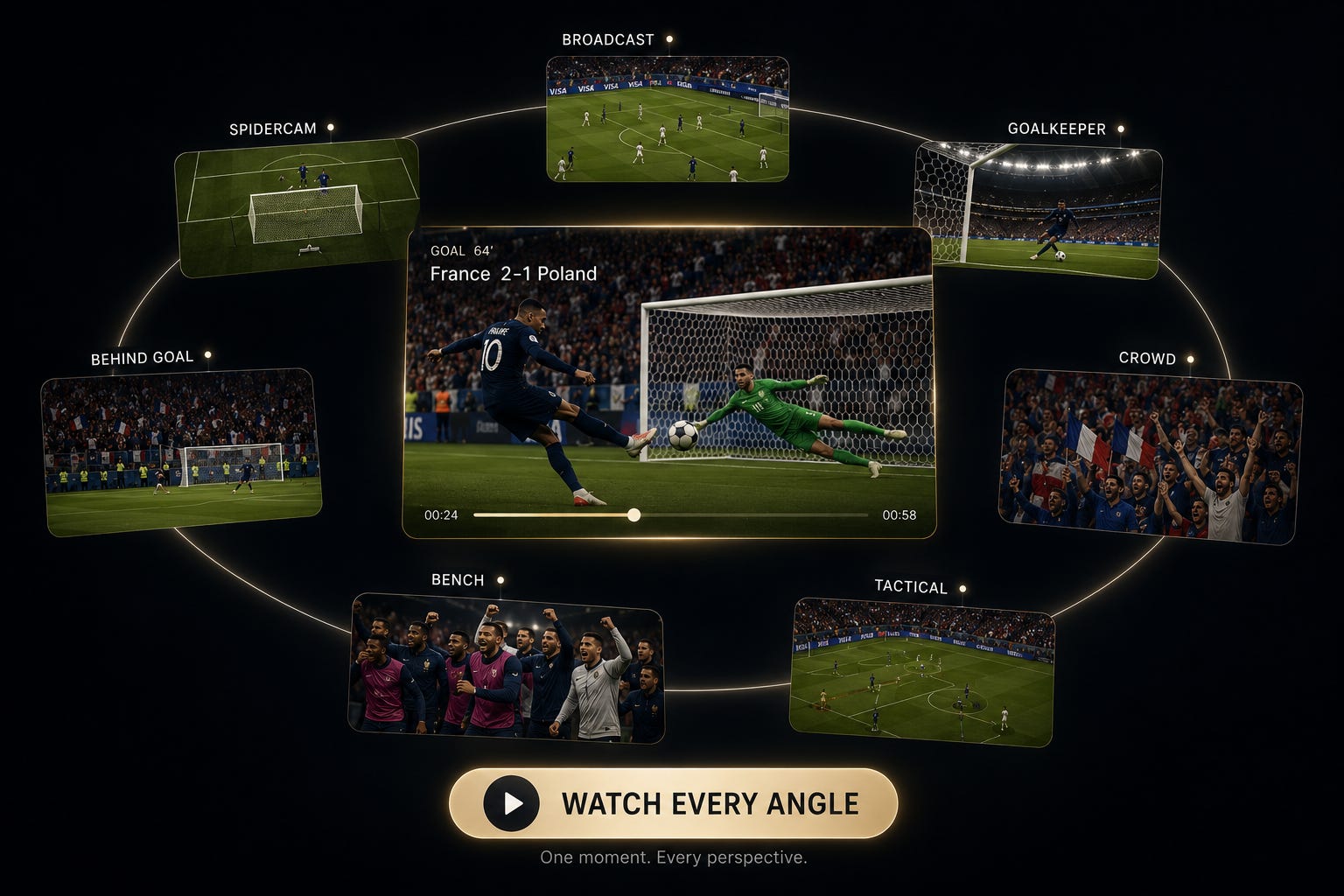
If I clicked on a goal, it’s because I want to experience that goal.
Show me:
Broadcast angle
Tactical angle
Behind-goal angle
Goalkeeper angle
Spidercam angle
Crowd reaction
Bench reaction
And then give me a one-click option to watch all of them in sequence.
The best moments in sports are often more enjoyable on the second, third and fourth viewing than the first.
That’s why slow-motion replays exist in the first place.
In fact, I explored this idea in more detail in The One-Click Slow-Motion Replay Button Every Sports Streaming App Is Missing, where I argue that replay itself deserves to become a first-class product experience.
Yet most streaming platforms still treat replays as something to get through quickly before returning to the rest of the program.
They should treat them as experiences.
The replay isn’t an interruption.
For many fans, it’s the destination.
A great goal isn’t one moment.
It’s a collection of moments viewed from multiple perspectives.
The internet doesn’t force us to choose a single angle anymore.
So why are we still behaving as though it does?
Let Creators Participate
For decades, broadcasters protected distribution.
That made sense when distribution was scarce.
Today, distribution is abundant.
Attention is scarce.
Sports organizations still spend enormous energy trying to control clips, reactions and redistribution.
The better strategy may be the opposite.
Provide official clips.
Provide official goals.
Watermarked.
Easy to share.
Easy to remix.
Let creators react, analyze, celebrate, criticize and explain.
Every creator becomes a distribution channel.
Every reaction becomes marketing.
Every remix becomes discovery.
The goal shouldn’t be to stop people talking about your sport.
The goal should be to make talking about your sport effortless.
Reels Are Not The Enemy
Many broadcasters seem to believe that reels and short-form video are stealing attention from full matches.
I think they’re looking at the relationship backwards.
Reels are not the competitor.
Reels are the funnel.
A fan might discover a player through a clip.
Watch a highlight package.
Watch an extended recap.
Watch a full match.
Become a tournament follower.
These formats are not competing with one another.
They are different stages of engagement.
The best sports platforms will treat short-form and long-form content as different entry points into the same experience.
Reels create curiosity.
Streaming satisfies it.
One shouldn’t compete with the other.
They should feed each other.
Sports Streaming’s Real Competitor
Sports streaming companies still think their competitors are other sports streaming companies.
They aren’t.
Their competitors are YouTube, TikTok, Instagram and every platform that has taught users to expect discovery, personalization, participation and control.
Sports streaming has already started borrowing some of YouTube’s language.
Better thumbnails.
Editorial collections.
Highlights.
Shorts.
Team pages.
That’s progress.
But YouTube’s real innovation was never the thumbnail.
It was building an experience around curiosity.
It asks:
What are you interested in today?
Sports streaming still mostly asks:
Which video would you like to watch?
Those are fundamentally different questions.
The question is no longer:
Can people watch the match online?
That problem was solved years ago.
The question now is:
Can people navigate sports content the way they navigate the rest of the internet?
And right now, the answer is largely no.
Rethinking sports broadcasting from first principles
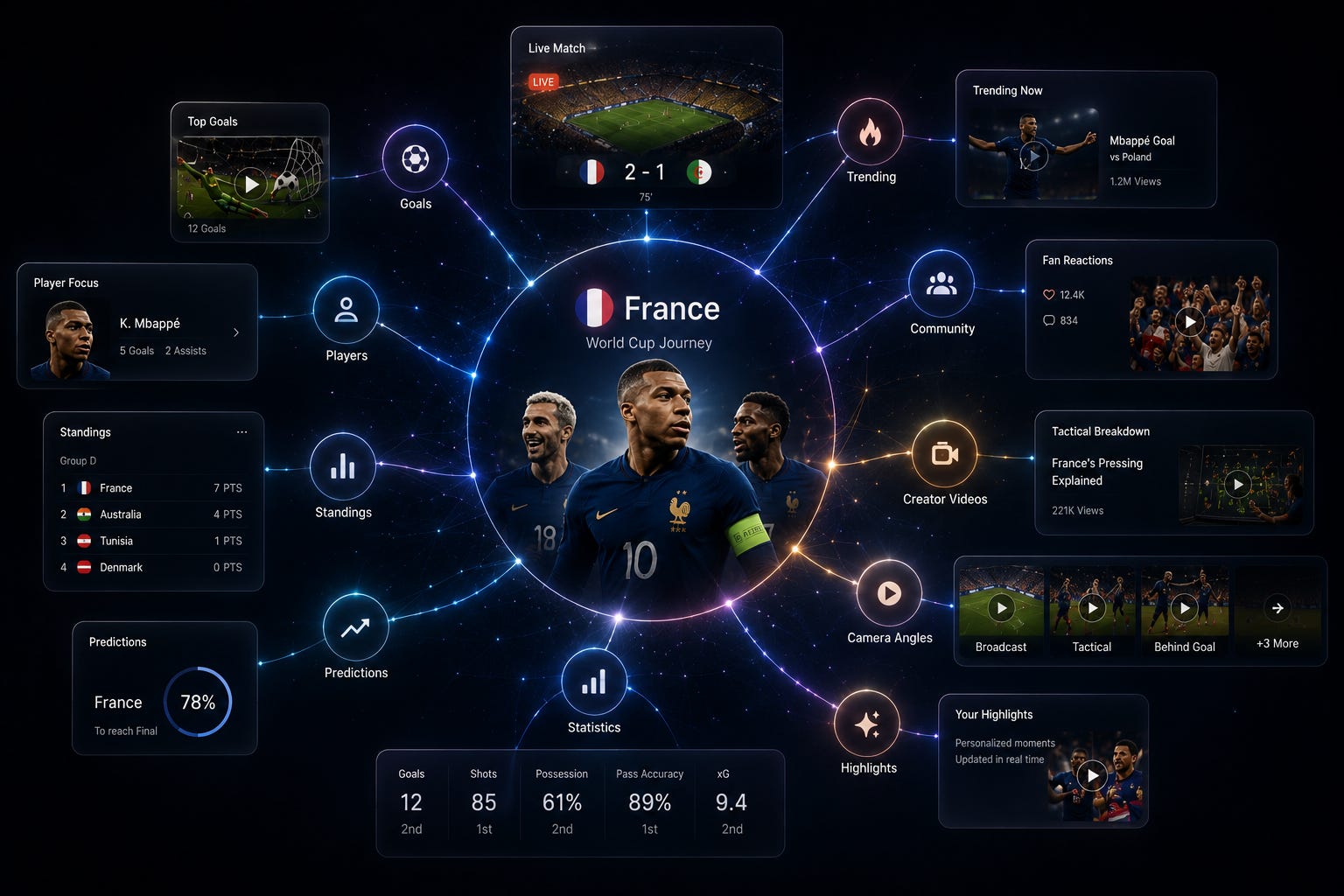
If I were rebuilding sports streaming from scratch today, I wouldn’t start with matches.
I’d start with stories.
Follow a country.
Follow a player.
Follow a tournament.
Follow a narrative.
Or follow a moment.
Or a rivalry.
Or a style of play.
Let every fan define their own journey through the tournament.
Let users choose the moments they care about.
Let them choose the perspective they watch from.
Let them sort, filter and discover.
Let them see what the rest of the world is watching.
Let them experience great moments from every angle.
Let creators amplify those moments across the internet.
And let streaming and social media work together instead of competing for the same attention.
Television optimized for channels.
Streaming optimized for on-demand viewing.
The next generation of sports platforms should optimize for curiosity.
Because curiosity leads to discovery.
Discovery creates stories.
And stories are what fans remember.
The future of sports streaming isn’t Netflix for sports.
It’s YouTube for sports.
Not because people want shorter videos.
Because they want to follow their curiosity, not your broadcast schedule.
And every year the industry fails to realize this, YouTube gets one step closer to becoming the place where sports ultimately belong.
Television perfected broadcasting.
The internet will perfect discovery.
The company that brings those two worlds together won’t just build a better sports streaming platform.
It will redefine how fans experience sport.
If anyone at FIFA+, YouTube, Zee5, JioHotstar, Netflix or Amazon is reading this:
Build This Next.
I write about how products can be better — fixing what’s broken and imagining what’s missing.
If this made you notice something broken or missing, you can subscribe to Build This Next to receive future essays directly.
Every subscription is a vote for building better products.
And if this sparked an idea, take a few seconds to share it — it might help someone else build or see products differently.